Comparing container orchestrators
This page presents a comparison between Eclipse Ankaios and the lightweight Kubernetes distribution K3s. All benchmarks were run on identical virtual machines in a controlled environment.
Test environment
Host machine
| Property | Value |
|---|---|
| CPU | Intel Core i7-11850H @ 2.50 GHz (8 cores / 16 threads) |
| RAM | 16 GiB |
| OS | Ubuntu 24.04 via WSL2 (Windows) |
Virtual machines are managed with Incus on the host.
Virtual machine configuration
| Property | Value |
|---|---|
| VM image | Ubuntu 24.04 (noble) |
| vCPUs | 4 |
| RAM | 4 GiB |
| Disk | 20 GiB |
One VM was used per orchestrator, reset to a clean snapshot before each measurement. No workloads were running during idle measurements. Benchmark images were pre-pulled into the snapshot so that no registry pulls occur during runs and the measurements are not influenced by network latency or bandwidth fluctuations.
Orchestrators used
| Property | Eclipse Ankaios | K3s |
|---|---|---|
| Version | v1.0.0 | v1.35.4+k3s1 |
| License | Apache-2.0 | Apache-2.0 |
| Runtime | Podman | containerd (bundled) |
Feature comparison
| Dimension | Ankaios | K3s |
|---|---|---|
| Focus | Automotive / embedded (SDV) | Edge / IoT |
| Language | Rust | Go |
| Workload types | OCI containers (multiple runtimes) | OCI containers |
| Multi-node orchestrator | ✔️ | ✔️ |
| Reconciliation loop | ✔️ | ✔️ |
| API access for workloads | ✔️ | ✔️ |
| Supports dependencies | ✔️ | ❌ |
| Flash wear-out prevention | ✔️ | ❌ |
| Requirement tracing | ✔️ | ❌ |
Benchmark results
Each benchmark was run 100 times per orchestrator; results below are averages. Memory figures use PSS (Proportional Set Size) from /proc/<pid>/smaps_rollup rather than RSS to avoid double-counting shared pages. Scenarios using polling do so with a sampling time of 100 ms.
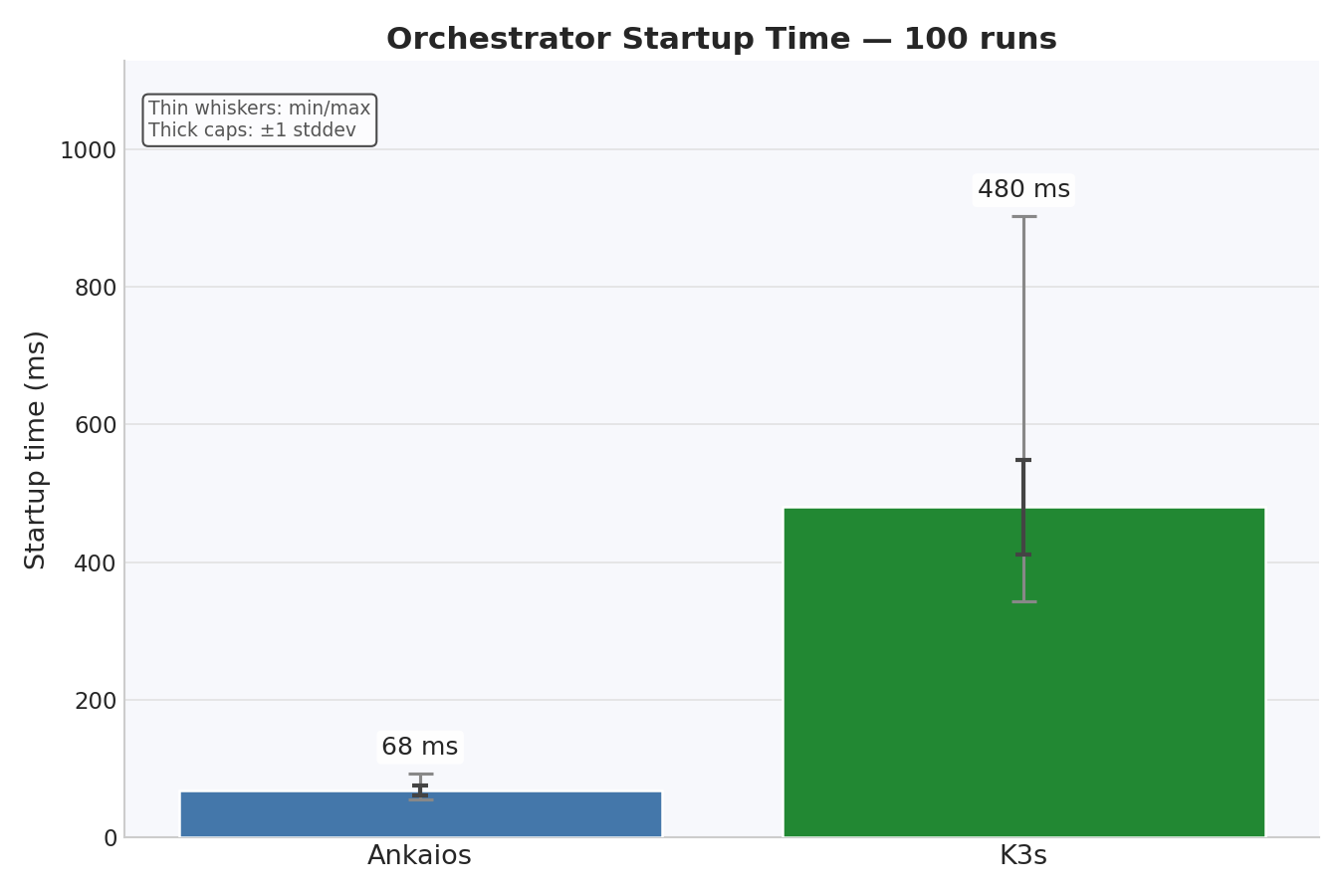
Startup time
Startup time measures how long each orchestrator takes from process launch until its management API is responsive.
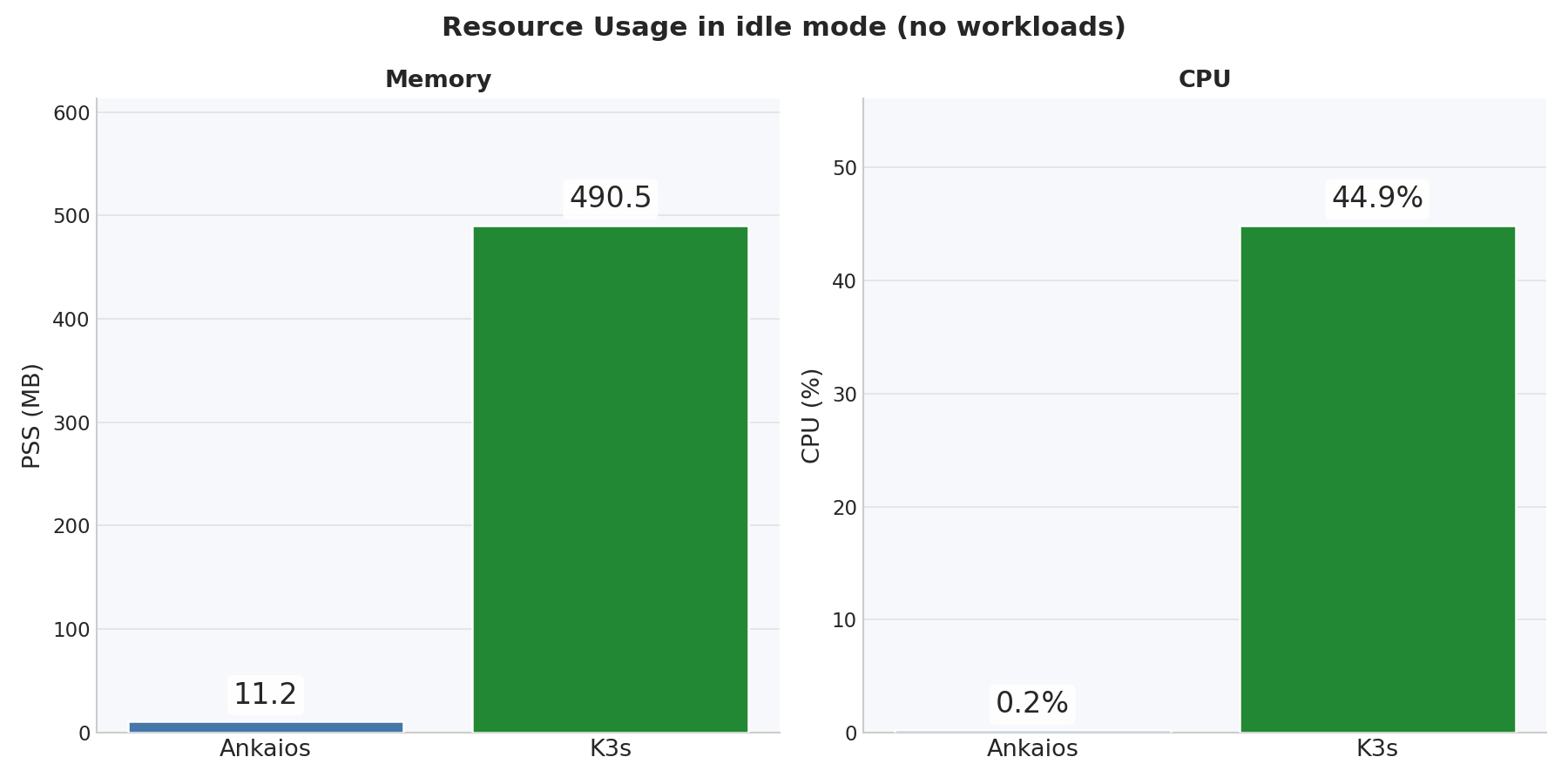
Resource usage in idle mode
Resource usage in idle mode is measured after each orchestrator has started and stabilized, with no workloads running.
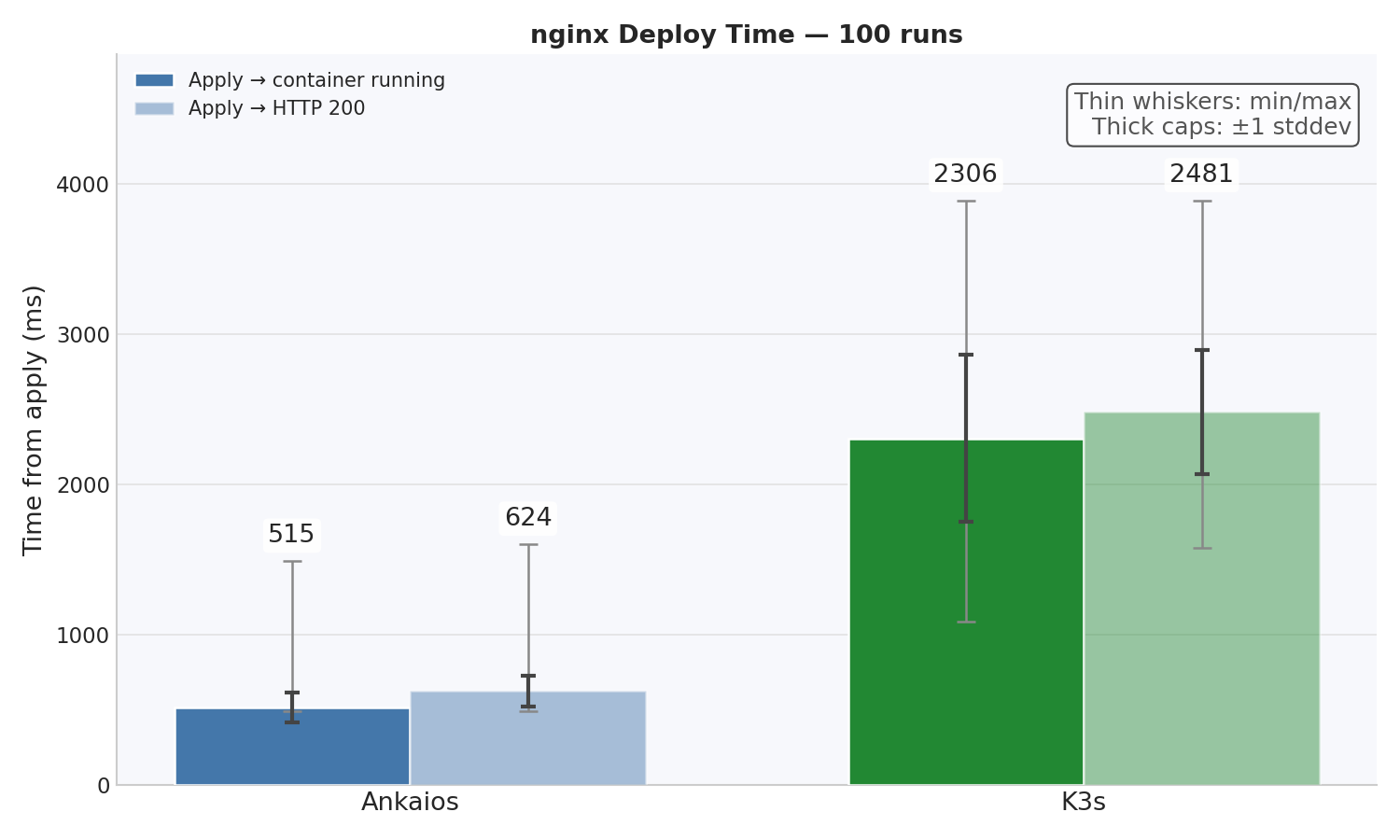
Workload deployment time
This scenario submits an nginx manifest and measures the time until the first HTTP 200 response, the true end-to-end deployment time.
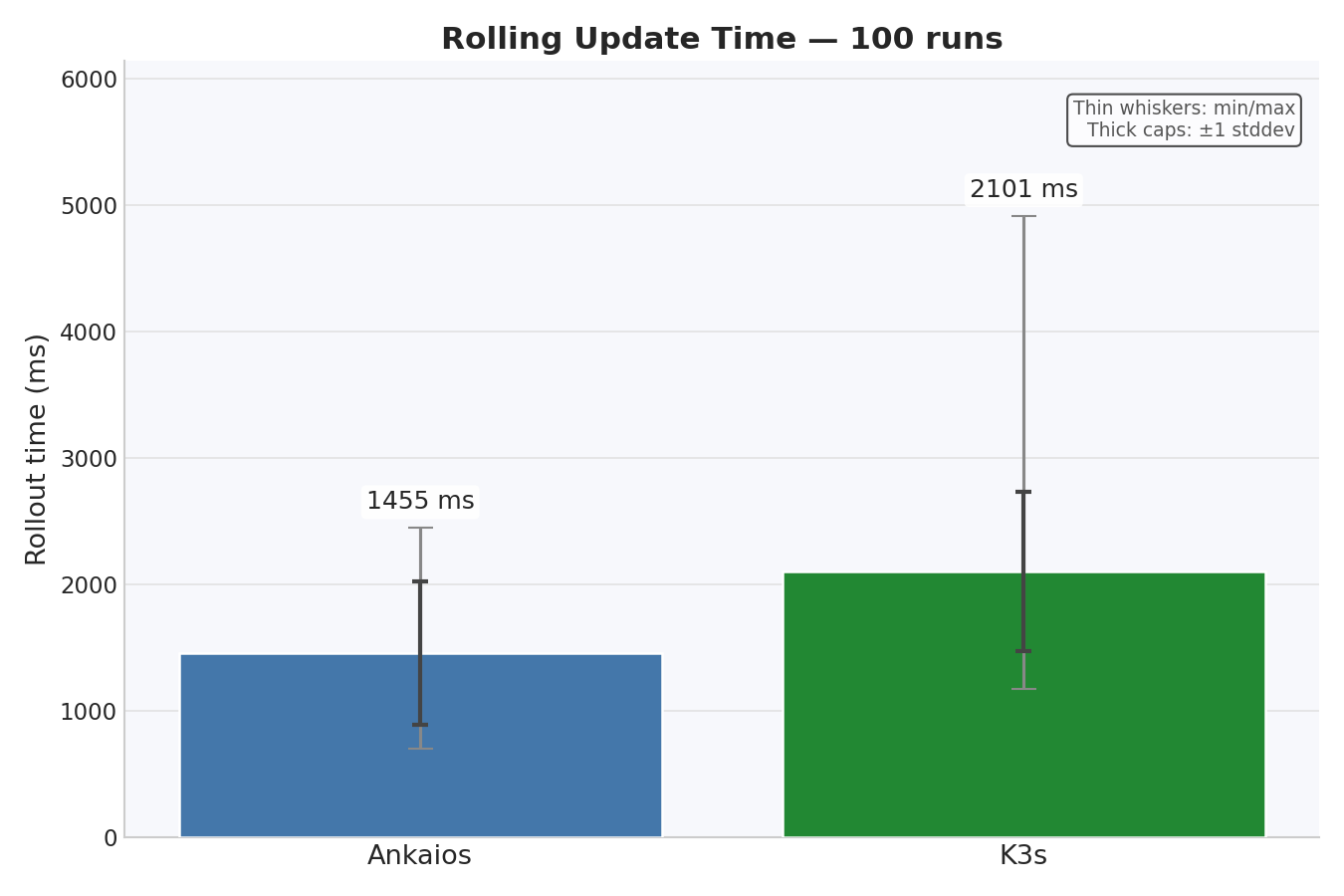
Rolling update time
Rolling update time measures from manifest re-submission until the updated workload is serving traffic.